Cart
0
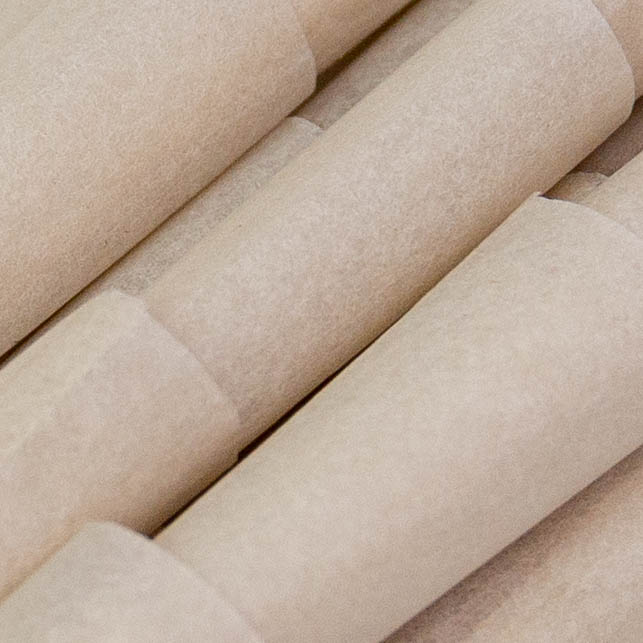
Ask any dispensary buyer why a pre-roll SKU got delisted and you will rarely hear "the flower was bad." Far more often, the complaint is about the cone itself: it canoed, it ran down one side, it went out twice, it tasted like glue. Burn quality is not a cosmetic detail — it is the single most visible expression of pre rolled cone quality, and it is decided long before the cone reaches a filling machine.
This guide breaks down the science behind an even, slow burn: paper weight (GSM), gum line width, combustion chemistry, and the dimensional tolerances that keep automated fill lines running. If you buy pre-rolled cones in bulk, these are the specifications that separate a reliable supplier from a cheap one.
Paper Weight (GSM): The Foundation of Burn Behavior
GSM — grams per square meter — measures the basis weight of the paper. Most commercial rolling papers fall roughly between 12 and 25 GSM. Where a cone sits in that range shapes almost everything about how it smokes.
Heavier paper carries more combustible cellulose per square centimeter. That means more paper smoke mixed into every draw, more visible ash, and a hotter, faster burn front. Lighter paper contributes less of its own combustion byproducts, so the flavor that reaches the consumer comes from the flower, not the wrapper.
Why Ultra-Thin Matters
Ultra-thin papers — typically in the 12–14 GSM range — offer three advantages that matter commercially:
- Cleaner flavor. Less paper burning means less interference with terpene expression, which is exactly what premium flower brands pay for.
- Slower effective burn. Counterintuitively, thin paper often burns more evenly because the burn front is driven by the packed material rather than the wrapper racing ahead of it.
- Less ash. Lower basis weight produces finer, lighter ash — a small detail that consumers read as "premium."
The trade-off is handling strength. Ultra-thin paper demands tighter manufacturing control: it tears more easily during rolling, filling, and packing. A supplier running thin paper on poorly calibrated equipment will ship cones with micro-tears that only reveal themselves when your fill machine vibrates them at speed.
Slow-Burn Chemistry: What Actually Controls the Burn Rate
Paper does not burn at one universal speed. Three variables govern it:
Porosity. The air permeability of the sheet determines how much oxygen reaches the combustion zone. Consistent porosity across the sheet is what produces a straight, even burn line. Inconsistent porosity — common in low-grade paper — creates fast and slow zones that turn into runs.
Fiber source. Wood pulp, hemp, and rice-based papers each burn differently. Longer, more refined fibers produce a more uniform sheet structure and a more predictable burn.
Mineral content. Papermakers use fillers such as calcium carbonate to regulate combustion and ash formation. In a well-engineered paper, the mineral load is calibrated so the paper smolders in step with the flower rather than sprinting ahead of it.
This is why "slow-burn paper" is a real engineering claim, not a marketing flourish — but only when the mill controls porosity and mineral content lot to lot. That consistency is something a buyer can and should ask a supplier to stand behind.
The Gum Line: A Few Millimeters That Decide Everything
The gum line is the adhesive strip — traditionally food-grade gum arabic from the acacia tree — that seals the cone along its seam. It is a few millimeters wide, and it is where cheap cones fail.
Why Width and Application Matter
An adhesive seam burns differently than the paper around it. A gum line that is too wide or too heavily applied creates a dense, slow-burning stripe running the full length of the cone. As the cone burns, the paper opposite the seam burns faster than the seam itself — and the burn "runs" down one side. That is the mechanism behind most canoeing complaints that get blamed on the flower.
A well-executed gum line is:
- Narrow — wide enough to hold the seam under machine vibration, no wider.
- Evenly applied — no blobs, gaps, or double-thick zones along the seam.
- Neutral in flavor — properly dried gum arabic is effectively tasteless; over-application is what produces the "glue taste" consumers describe.
- Fully cured — under-dried adhesive weakens in humid storage and lets seams open during filling.
Runs and Canoes: An Engineering Problem, Not Bad Luck
A "run" is a burn line racing down one side of the cone; a "canoe" is the trench it leaves behind. Both trace back to a short list of causes, and every one of them is controllable:
- Uneven pack density — loose pockets burn fast, dense pockets burn slow. Partly a filling issue, but cone geometry that varies unit to unit makes consistent packing impossible.
- Inconsistent paper porosity — a mill-side defect no amount of careful packing can fix.
- Heavy or uneven gum lines — the seam-versus-paper burn differential described above.
- Wrinkles and folds — creases from sloppy rolling create thick spots that stall the burn front.
When a pre-roll program sees recurring canoe complaints, the cone specification — paper, gum, and rolling consistency — is the first place to audit.
Cone Sizes and Typical Fill Weights
Burn behavior also scales with format. A longer cone holds more material, burns longer, and exposes any paper or gum inconsistency over a greater distance. Standard formats and their typical fill weights:
| Format | Length | Typical Fill Weight | Common Use |
|---|---|---|---|
| Dogwalker | 70 mm | ~0.3 g | Multi-packs, minis |
| 1¼ Size | 84 mm | ~0.5–0.75 g | Standard single pre-rolls |
| 98 Special | 98 mm | ~0.75–1 g | Full-gram value formats |
| King Size | 109 mm | ~1–1.3 g | Premium singles |
These same principles apply across specialty formats — blunt cones, glass-tip cones, and wooden-tip cones — where tip weight and wrap composition add their own burn variables.
Fill-Machine Tolerances: Where Cone Quality Meets Throughput
For licensed producers, cone quality is also an operations question. Automated filling systems from Futurola (Knockbox line), STM Canna (RocketBox line), and King Kone load anywhere from around a hundred to several hundred cones per cycle into a tray or grid, then fill them simultaneously under vibration.
These machines assume dimensional consistency. Every cone in the tray must match on:
- Overall length — over-length cones protrude and take uneven fill; short cones under-fill.
- Tip diameter and tip length — the tip is what seats the cone in the loading plate; variance here causes tilted cones and spillage.
- Mouth diameter and taper — inconsistent taper changes how material settles under vibration, producing the density variations that cause canoeing.
- Seam strength — a weak gum line that survives hand-rolling can still split under machine vibration, scrapping the cone and contaminating the tray.
A batch of cones with sloppy tolerances does not just smoke badly — it slows the line, raises scrap rates, and wastes trimmed flower. When evaluating a cone supplier, ask which machine platforms their cones are validated against and what dimensional consistency they hold batch to batch. ConesWorld manufactures to Futurola, STM Canna, and King Kone compatibility specifications, with quality documentation — including COAs and MSDS — available on request, and paper sourcing and management-system certifications (FSC-certified paper, GMP, ISO 9001:2015) documented for B2B partners.
The Buyer's Checklist for Pre Rolled Cone Quality
Before committing to volume, verify five things:
- Paper GSM and fiber source, specified in writing.
- Gum line material and application consistency — inspect seams across a sample batch, not a single cone.
- Burn testing — fill and smoke-test samples; look for straight burn lines and self-extinguish behavior.
- Dimensional tolerances and named machine compatibility.
- Batch documentation — COAs, MSDS, and certification records on request.
Source Machine-Ready Cones at Scale
ConesWorld supplies bulk pre-rolled cones and pre-rolled tubes to licensed producers and distributors, with stock MOQs from 50,000 units (7–15 business days) and custom programs from 100,000–250,000 units (15–30 business days).
Building your own pre-roll brand? Explore our white-label program, or start a supply conversation through our B2B partnership page. You can also reach our team directly at business@conesworld.com or +1 (725) 277-0408.